
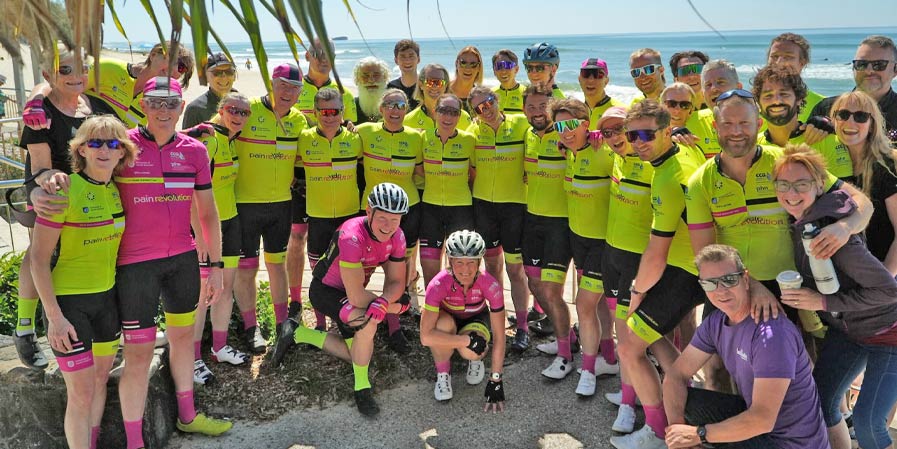
Stories of the challenge of providing healthcare in rural Australian settings are common. Limited resource access, professional isolation, limited opportunities for professional development, are often in focus. Pain Revolution, a non-for-profit initiative of the University of South Australia instead focuses on the unique strengths and opportunities of rural and regional communities, working closely with them to build local capacity for good quality pain care.
Pain Revolution supports rural healthcare providers to become Local Pain Educators (LPEs). The training is comprehensive – LPEs complete a one-year Pain Science and Education Certificate program at the University of South Australia, a range of webinars and workshops, and are then individually supported to organise ‘Local Pain Collectives’ or groups of healthcare providers. LPEs lead their collective through a five-session professional development and connection program. I recently had the pleasure of speaking with four LPEs from Queensland’s Sunshine Coast and Wide Bay region to learn about their experiences of the program.
Tyson McEwen built a Local Pain Collective in Coolum. He described how it generated local referral and peer support systems – “I now have someone to talk to if I want to get a second opinion or if I want to discuss uncertainty when working with complex presentations.”
Tim Bagshaw led the Maleny Local Pain Collective. He echoed the value of skills, support and connection, but drew a bigger picture of a wide virtual community with real on-call value: “before I became an LPE, I was a siloed private practice physiotherapist. I would speak to a GP, surgeon, rheumatologist or neurosurgeon occasionally, but not very often… Now being surrounded by the whole Pain Revolution community means I can pick up the phone to call anyone of at least 20 people who are going to be more than happy to help me out.”
Mitchell Shorten, LPE from Bundaberg, described the Pain Revolution program as building knowledge, skills and confidence in working with chronic pain patients, and helping him “develop a network of like-minded people across the nation that I can tap into at any time and ask for advice, opinions and feedback… I’m connected to inspiring clinicians who are achieving great things in their own towns. It gives me new ideas and plans for what I can do in my own area.”
This Sunshine Coast and Wide Bay group of LPEs are excited for the upcoming Pain Revolution Rural Outreach Tour, which is running from Bundaberg to Caloundra during the last week of August, supported by the Country to Coast (CCQ) PHN. The tour will involve seven community outreach events, interactive stalls, covering cutting edge pain science and including lived experience accounts of challenge and recovery – all aiming at piquing community interest in the scientifically-based hope of modern pain science and care.
These LPEs have also been integral to a new initiative. In collaboration with Sunshine Coast Persistent Pain Service and CCQ PHN, Pain Revolution has developed the Community Pain Champions program. Local community members who are not healthcare providers will gain knowledge and skills in modern pain education. The named LPEs will each mentor five Champions through training and delivery of ‘Community-tailored Pain Education plans’. It’s a world first; enrolment of the first cohort starts in October.
LPE Jay Whittem envisioned the Community Pain Champions program as the ideal next step in community transformation around pain and its management. “It’s practical, pitched at that right level, and co-designed with the Champions themselves. These community members have immense experience and expertise that is unique from what us clinicians can offer. I’m excited to see them reach new communities in new and powerful ways.”
What if your local coffee shop had the answers to one of humanities greatest challenges? Chronic pain has a staggering Read more