


What if your local coffee shop had the answers to one of humanities greatest challenges? Chronic pain has a staggering toll, both in disability and economic cost. It’s a burden that, while undeniably real, often remains an invisible struggle – one that weighs heaviest on our rural and remote communities.
Turns out, the answer might not come from a new drug or specialist clinic, but from the local café, footy club, or town library.
This is the vision behind EQUiPP, a research project from Adelaide University in partnership with Country SA and Western Victoria PHNs, focused on seven rural towns on the South Australian Limestone Coast and in Western Victoria. The research team has identified two roadblocks to chronic pain care in rural Australia. First, many health professionals feel that they lack the specific skills, support, and resources to deliver the best pain treatments, such as pain education. Second, people are often unaware of how powerful learning about pain and active self-management can be, so these approaches are not yet widely sought or expected.
We believe the solution isn’t a new pill, but a new conversation. Changing how people understand pain means changing how we talk about it. But this can’t be done to rural communities, it has to be done with them.
Past public health campaigns have made this mistake. When outsiders design interventions without community insight, they risk missing the mark, or worse, widening existing inequalities. Every town has its own rhythm, language, and social fabric. What resonates in Adelaide might fall flat in Mount Gambier for example.
This is where co-design comes in. A simple and powerful force for change, instead of researchers designing solutions for a community, they design it with them.
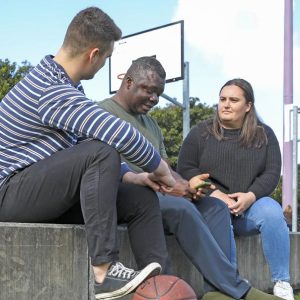
In the middle of 2025, the EQUiPP team visited Mount Gambier, Millicent, Naracoorte, Hamilton, Ararat, Stawell, and Horsham to tackle chronic pain. Across 6 weeks, 19 co-design workshops were held, bringing together 232 local people. The ‘experts’ in the room weren’t researchers – they were local employers, farmers, and people living with chronic pain, in fact, they were anyone who lived in the town.
Together, we sat down to design a way forward. Local co-designers shared insights about how information travels in their towns, which voices are trusted, and what language feels authentic to make the campaign theirs, not the city’s or neighbouring towns’. Community members evaluated pain messages, the best items and places to share them, reviewed campaign styles, and managed a budget to prioritise their ideas.
Harnessing the power of collective creativity, communities looked beyond a flyer at the GP clinic. Think QR codes on a morning coffee cup or on a beer coaster at the pub.
Messages that were clear, relatable, and, above all, validating, were a top priority. A simple phrase like, “Pain is always real and personal,” resonated deeply. “Many factors influence pain” was another popular message, highlighting that pain is complex, things like stress, work, relationships, past experiences, beliefs and even the things we smell can influence our pain system.
Alongside the development of the community-facing campaign, we are also training and supporting local health professionals to deliver best practice chronic pain care.
By building on local wisdom and empowering local health professionals, the EQUiPP project is putting communities in the driver’s seat, because when it comes to tackling one of humanities biggest challenges, the local coffee shop might just hold the answer.
Rural mental health professionals face unique challenges – from professional isolation to high caseloads and limited peer support. But innovative Read more

Stories of the challenge of providing healthcare in rural Australian settings are common. Limited resource access, professional isolation, limited opportunities Read more
One third of Australians live in rural, regional, and remote areas. Delivering quality health education, research, and services to these Read more
Grampians Health has launched a dedicated mobile clinical trials unit bringing research, innovation, and care directly to Western Victorian regional Read more