
Across rural and remote Australia, access to healthcare is not just a question of availability, it’s a question of economics.
For families living hundreds of kilometres from specialist services, the true cost of healthcare is rarely limited to the consultation fee. It is measured in lost school days, time away from work, income foregone, fuel costs, overnight accommodation, and hours off the land. It is measured in fatigue, disrupted routines, and difficult trade-offs between health and livelihood.
For over 20 years, Angel Flight Australia has worked to bridge this gap.
The hidden cconomic burden of distance
Angel Flight coordinates free non-emergency flights and ground transport for people in rural and regional Australia who need to access specialist medical care far from home. Volunteer pilots and drivers donate their time and aircraft so that distance does not become a barrier to care.
But beyond the humanitarian lens lies a powerful economic story.
When a patient in a remote community must travel 600–1,000 kilometres for a medical appointment, the ripple effects are substantial. A parent may need to take multiple days off work. A farmer may need to leave stock unattended during a critical season. A small business operator may close their doors for the day, and a child may miss school for the day, not once, but repeatedly.
Over time, these missed days compound. Educational continuity suffers. Productivity declines. Stress increases. For families already operating on tight margins, these impacts are significant. Ines D’Ambrosio, a mother of three from the NSW town of Griffith, knows this struggle all too well. Her daughters, Amilah and Liliana, have complex neurogenetic conditions that require ongoing specialist treatment. Yet, in Griffith, accessing vital services like speech therapy can mean waiting years for an available provider. Ines’ family spent six years on a waitlist before securing an appointment, an unacceptable delay for any child needing early intervention.
By providing free flights that dramatically reduce travel time, Angel Flight helps restore hours, sometimes days back to families. A journey that would otherwise require a full day’s drive each way becomes a morning flight and an afternoon return home.
The economic benefit is rarely captured in formal health budgets, yet it is real and measurable in lived experience.
Angel Flight’s service reduces indirect costs, those hidden, compounding costs that sit outside Medicare item numbers but deeply affect rural resilience.
In doing so, it strengthens not only individual health outcomes, but also community sustainability.
From transporting patients to transporting specialists
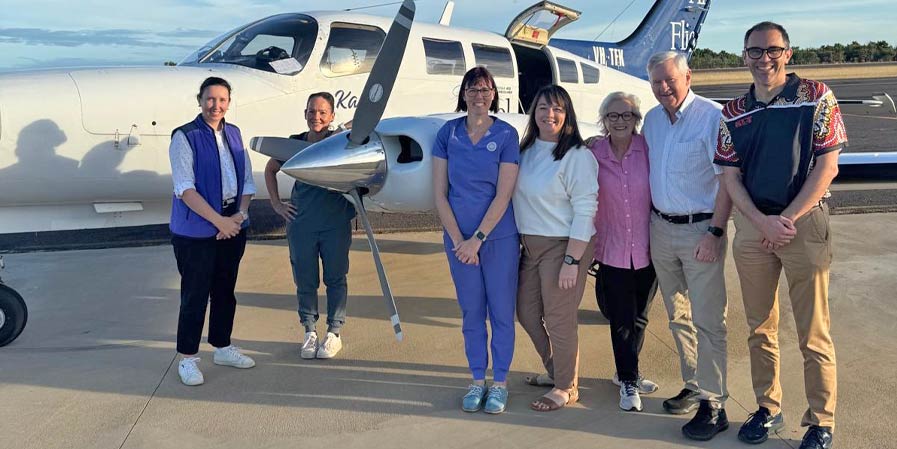
In 2024, Angel Flight expanded its model with the introduction of Rural Medi-Flights, a systemic shift that addresses the rural health gap from a different angle.
Rather than bringing patients out of their communities, Rural Medi-Flights brings specialist medical professionals into rural and remote towns.
Using a dedicated high-speed aircraft, under a Air Operators Certificate (AOC) health professionals are flown directly to communities to deliver clinics locally, then returned home the same day or aligned to their schedule.
By removing distance as a primary barrier, Angel Flight addresses a core structural inequity.
Importantly, this model is cost-effective not only for families but for the broader health system. Earlier access to care reduces the likelihood of delayed treatment, emergency presentations, and advanced disease progression, all of which carry higher system-wide costs.
Preventative and early specialist care is almost always more economical than late-stage intervention.
When evaluating rural health policy, we must broaden our lens beyond direct clinical expenditure.
True health economics includes educational continuity, workforce participation, agricultural productivity, small business stability, mental health and family resilience and community sustainability.
Angel Flight’s work demonstrates that targeted, aviation-based solutions can produce outsized economic returns, not just in dollars saved, but in opportunity preserved.
In rural Australia, distance has always carried a cost.
The question is not whether we can afford to close that gap.
It is whether we can afford not to.

In one small town, a mother anxiously refreshes her browser, hoping her specialist’s face will flicker onto the screen. Hours Read more

The cost of accessing health care is a growing concern across Australia. For people living in rural, regional and remote Read more

Six-year-old Billie lives in the remote South Australian town of Bramfield, on five acres with her mum Bec, dad, two Read more
When I first started working on South Australia’s Eyre Peninsula 14 years ago, I stepped into a very different kind Read more