
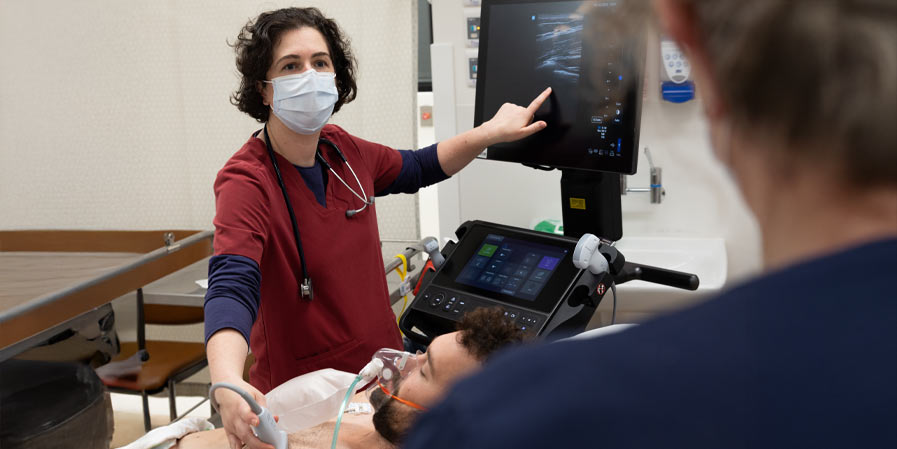
For Dr Rebecca Devitt, providing high-quality maternity care in rural Australia is both a passion and a necessity. As a Rural Generalist (RG) with advanced skills in obstetrics and gynaecology, she plays a critical role in ensuring that women and their families can access safe and comprehensive maternity services close to home. However, she knows firsthand the challenges rural communities face in maintaining these essential services.
Growing up in Mudgee, New South Wales, Dr Devitt developed a strong connection to rural communities. She initially completed an undergraduate degree in before deciding to pursue a medical degree at the University of Wollongong. Her interest in rural medicine and obstetrics was solidified during a placement in Forbes, New South Wales.
“The reason I chose ACRRM and rural generalism as a career path was because I just wanted to do everything,” she says. “I couldn’t necessarily narrow down a specialty that I wanted to do exclusively.”
Training through the Australian College of Rural and Remote Medicine (ACRRM) allowed Dr Devitt to develop a wide range of skills, building her confidence to deliver exceptional care across multiple healthcare settings. It gave her the ability to support her beloved rural community of Mudgee by working in both general practice and hospital environments.
“In rural and remote medicine, you just don’t know what’s going to come through the door,” she explains. “Sometimes you have to step up and manage something very emergent. “Other times, you need to be a problem solver, figure out what’s going on, and find the best way to help the patient.”
While she thrives in the fast-paced, unpredictable world of emergency medicine, Dr Devitt’s is equally comfortable working in maternity care.
“I’ve always really loved doing obstetrics. “It’s a great combination – you do some medicine, you do some surgery, and you build long-term relationships with your patients,” she says. “Being able to provide continuity of care throughout pregnancy and birth is incredibly rewarding.”
Now a staff specialist at Mudgee Hospital, Dr Devitt splits her time between emergency care and maternity services. Her dual role highlights the versatility and importance of Rural Generalists, particularly those with advanced skills in obstetrics, in sustaining healthcare services outside the urban footprint.
Dr Devitt believes that Rural Generalist training equips doctors to provide truly holistic care.
“ACRRM training really equips you to have well-rounded rural skills so you can jump straight in and work in a hospital, in general practice, or other environments,” she says. “You’re not narrowed down to one line of work, and I think that’s the real benefit of Rural Generalist training with ACRRM.”
However, she warns that without enough RGs trained in obstetrics, rural communities risk losing these vital maternity services. The shortage of doctors with these skills leads to fewer birth services being available locally, meaning more women are forced to travel significant distances for care, often at great emotional and financial cost.
Dr Devitt’s experience reflects her deep commitment to rural communities and her passion for comprehensive healthcare. She embraces the diverse challenges and opportunities that rural medicine presents, striving every day to make a difference.
“When I look back on my career, I want to be able to say that I’ve been a good mother, wife, daughter, and friend. “I hope that the work I do every day makes a difference for people, and that I can continue to support and grow the medical community in Mudgee.”
Dr Devitt’s story is a testament to the indispensable role that Rural Generalists play in supporting maternity care in rural, remote and First Nations Australia. With appropriate investment in Rural Generalist training pathways, more doctors like her can continue to provide vital services, ensuring that women and families across rural Australia receive the care they deserve—close to home.
Find out more about Rural Generalists making a difference where they are needed most, at acrrm.org.au
In the vast Northern Territory, where red earth stretches beneath endless skies, women are embarking on powerful health journeys of Read more
In the back room of an old footy club—one of those spaces that carries the scent of instant coffee, eucalyptus, Read more

In rural towns across Australia, playgroups are more than just a space for children to play. They serve as vital Read more
From the far reaches of Cape York to the rugged beauty of Kangaroo Island, Angel Flight is proud to have Read more