

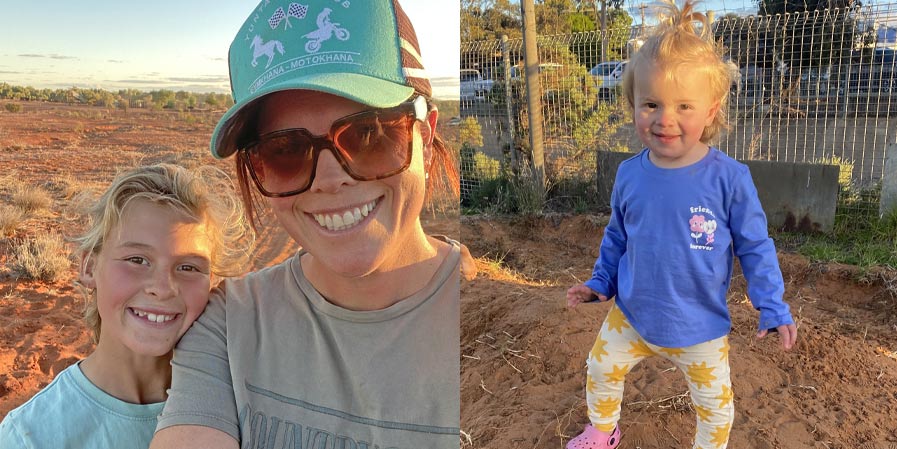
“The RFDS is vital to us because of where we live.”
— Amy Mannion, mother of five, sheep and cattle station owner, Broken Hill region.
Amy and her husband Nick live with their five children on a remote property, 200km north of Broken Hill. The Mannion’s, like many in NSW’s outback, rely on the not-for-profit Royal Flying Doctor Service South (RFDS) to access essential healthcare, from emergency services and late-night calls to the doctor, through to primary healthcare clinics and mental health support.
“We’ve used the Service a lot,” Amy said with a laugh, “Frequent flyers – you could say that. We should get our card stamped.”
Amy’s husband, Nick, is a sheep and cattle farmer. One day, Nick was unloading a truck when he slipped. He landed directly on a star picket and was badly injured. With the closest Emergency Room two hours away, the Flying Doctor was called in. According to Amy, “He landed pretty hard, but the Flying Doctor came to pick him up quickly. He got flown to Adelaide Hospital, and with the injuries he had, he ended up with fifty stitches.”
It wasn’t the only emergency the Mannion’s would call on the RFDS for. One day, Amy went through a fence on her property on her motorbike. She suffered four compression fractures in her spine, which resulted in the RFDS airlifting her to the hospital.
But some emergencies can be hidden under the surface. Take Amy and Nick’s daughter Imogen, for example. At just five years old, Imogen began pulling her hair out in clumps. This behaviour emerged during a difficult time as the family faced the devastating weight of drought. Imogen was helping feed the animals and could see them getting thinner and thinner. Some animals perished, and many others had to be sent away.
Seeking help, Amy reached out to our Clive Bishop Medical Centre in Broken Hill and was referred to our mental health team. Imogen began play therapy sessions with Leslie Harvey, our Child and Family Mental Health Clinician. The sessions were transformative.
Now 10 years old, Imogen thrives in her studies and enjoys family life on their remote station alongside her siblings Archie (6), Henley (5), Neve (3), and Callie (1).
Managing chronic conditions is also much more complex in remote locations. Archie, now six, has croup, a respiratory condition that can escalate without warning. For Amy, knowing she can call the Flying Doctor 24/7 brings vital peace of mind.
In addition to relying on the Flying Doctor for her own family, Amy is also an important community connection back to the RFDS as one of our many hundreds of Medical Chest Custodians. With pharmacies in short supply in remote and rural communities, Amy is the custodian of an RFDS-supported chest of medical supplies, ranging from antibiotics to pain medication, which can be administered at the direction of an RFDS doctor until help arrives or a doctor’s appointment can be made.
The RFDS isn’t just there for when things go wrong. An important part of our mission is ensuring that people have access to holistic and preventative primary healthcare. For any GP check-ups, vaccinations or prescriptions, the Mannion’s travel to Packsaddle, where the Flying Doctor has been running regular primary care clinics for many years. While the permanent population of Packsaddle usually hovers in the single digits, whole families travel from surrounding properties for an appointment or just a chance to catch up with their neighbours.
There are many young families in the surrounding area, with children of all ages enjoying a rich childhood on the land. Social connection is critically important for people of all ages, but, in particular, the very young. Our mental health team facilitates a regular ‘Storytime’ session at the same time as the Packsaddle clinics to create those moments for social connection, while also using reading and craft to support learning, growth and wellbeing. The Mannion kids are usually front and centre.
This all-of-health approach means the RFDS can equip communities with the care they need, no matter where they live. And with two-thirds of our workforce living in the communities we support, we are best placed to deliver that holistic care.
But we are different to many of our healthcare partners. The RFDS is a not-for-profit. More than half of its funding came from RFDS-driven philanthropy, bequests, donations, grants, and contracts last financial year. The Mannion’s, like many generous supporters, are heavily involved in Gymkhanas and local rallies to raise much-needed funds for the RFDS.
Amy puts it simply, “Without the RFDS, there’d be no one to call when we need help.”
In the outback, healthcare isn’t just about treatment – it’s about the right to build your life in the bush. And without it, life in the bush would become impossible.

It’s no secret that rural and remote communities are suffering from long standing healthcare workforce shortages. The Royal Flying Doctor Read more