
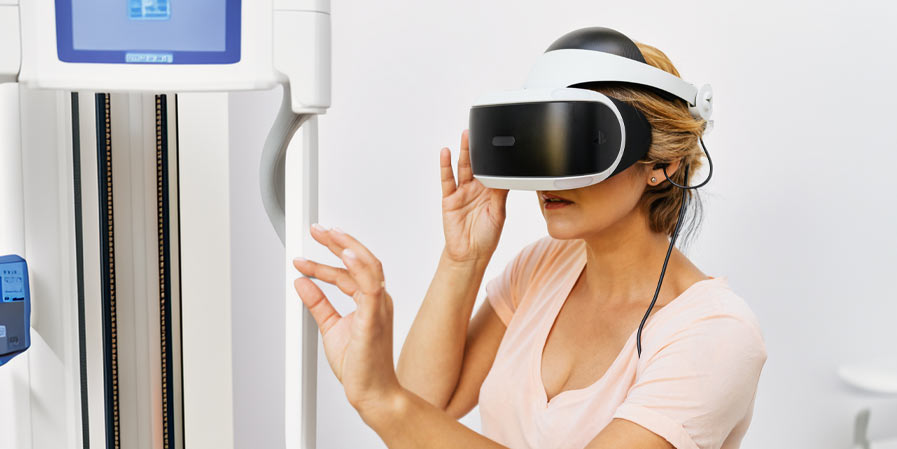
Imagine lying still under a large, unfamiliar piece of radiation therapy equipment, preparing to receive treatment for breast cancer – and being instructed to inhale deeply and then hold your breath for 20 seconds at a time. Could you do it? Or would you struggle?
During radiation therapy for breast cancer, patients are often required to perform this breathing task repeatedly until their treatment is complete. The technique of taking a deep breath and holding it is known as ‘Deep Inspiration Breath Hold’ (DIBH). DIBH is an important and effective tool to lower radiation exposure to the heart by moving it away from the patient’s breast. However, the technique can be difficult for patients to perform optimally – particularly for those experiencing anxiety. While education and coaching can improve a person’s ability and confidence to perform DIBH, these supports are not always readily accessible in rural and regional areas.
In Northern NSW, and now expanding across regional and rural sites in the state, Senior Radiation Therapist Kath Dower is working to address this gap through technological innovation, using Virtual Reality (VR) to support rural patients receiving radiation therapy for breast cancer.
During her work over the last five years, including in Lismore, Kath saw the difficulties many patients faced in performing the breath-hold technique. This sparked the beginnings of her research into the possibilities of education and coaching for improving breath-hold capability. She identified VR as a potentially powerful and accessible training tool to help rural patients increase their DIBH capacity – and improve their experience of radiation therapy, overall.
An NSW Regional Cancer Research Network (NSWRCRN) Shovel-Ready Research Grant (funded by the Cancer Institute NSW) supported the Virtual Reality Education Pilot Program component of Kath’s project, with virtual reality coaching and education offered to study rural participants. The VR experience uses videos and VR headsets to give rural patients a ‘real-life’ immersive view of what to expect when they plan for radiation treatment appointments, and provides them an opportunity to practice breath-holding.
Videos were filmed at participating cancer treatment sites to ensure they reflected the equipment and environment that patients living rurally would experience. The addition of noise-cancelling headphones during the immersive experience also helped to lessen the distraction and overwhelm that previous research has shown could affect a patient’s focus and ability to complete DIBH.
“Patients felt anxious, didn’t know what to expect. They had a fear of the unknown. And we found many just couldn’t do a deep inspiration breath-hold,” Kath said.
“So, we invested in virtual reality education to help people living rurally. When people were immersed in the VR experience, they were completely focused on whatever you were trying to educate them about. The approach really helped them overcome that fear of the unknown.”
Since initiating her research on DIBH, Kath has commenced a PhD with Curtin University. Additional support from the Northern NSW Academic Health Alliance and a Breast Cancer Trials Fellowship in 2025-2026 have enabled her to continue her work addressing challenges related to patients’ DIBH capacity in radiation therapy. This work is resulting in targeted interventions, including virtual reality coaching and education for rural communities, breathwork exercises, and additional pre-treatment opportunities to assess and improve patients’ ability to perform DIBH effectively.
Kath’s use of VR technology and her approach to the study’s design reflect a keen appreciation of the cancer treatment challenges faced by many patients living rurally, and a desire to improve their experience through the clever, considered use of emerging technology. In the area of radiation oncology and radiation therapy – already at the cutting edge of many approaches to cancer treatment – Kath’s work stands apart as a novel, locally-tailored, and technology-driven solution to the difficulties of treatment and the unique challenges of rural health care.
People affected by cancer in rural and regional communities need access to support at all stages of the cancer care Read more

It’s 4am, and I’ve been awake for 22 hours. My shift started at 2:30pm and the surgeries haven’t stopped all Read more
Rural mental health professionals face unique challenges – from professional isolation to high caseloads and limited peer support. But innovative Read more
Growing up in rural Queensland instilled in Dr Prue Wallin resilience, compassion, and a deep respect for community—values that shaped Read more