
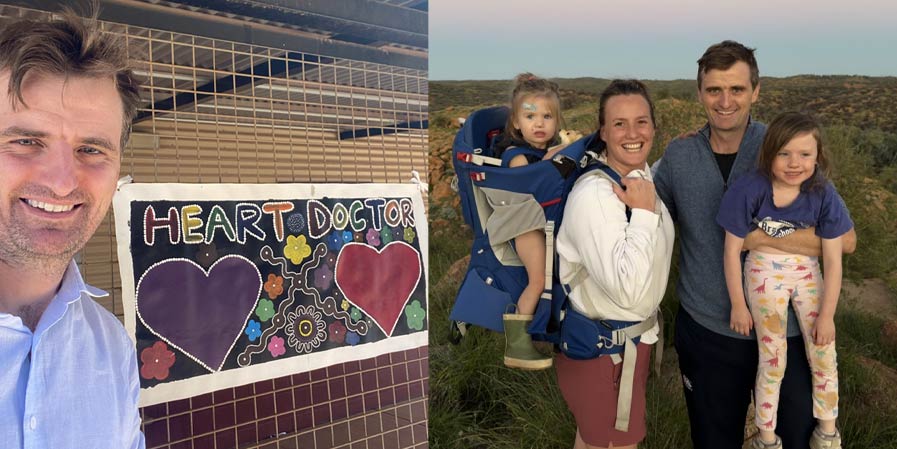
From an early age, Angus Baumann aspired to work in a rural or remote community. Growing up in the lower Hunter Valley of New South Wales, he witnessed firsthand the challenges of healthcare access in smaller towns. His hometown of 5,000 people often went without a GP, and the nearest hospital was nearly an hour away in Newcastle. Like many who enter medicine, he was motivated by the desire to help others. His choice to pursue cardiology was driven not only by interest, but by a recognition of the need: rural and remote areas carry disproportionately high rates of cardiovascular disease. In the Northern Territory, people outside Darwin experience heart attack and heart failure at three times the national rate, while acute rheumatic fever and rheumatic heart disease affect First Nations communities at 200 times the national average.
Unique Experiences in Central Australia
Since relocating to Alice Springs/Mparntwe in 2021, Baumann has travelled regularly to remote communities, meeting people who go to extraordinary lengths to access healthcare. At one clinic during the rainy season, a patient arrived damp and cold. When asked if she had been caught in the rain, she explained that flooding had cut off bus access from her community. Rather than postpone, she and her husband caught a lift to the river, swam across, and boarded the bus waiting on the other side. After her appointment, she calmly noted that she would swim back.
Other cases have been equally memorable. With the combined efforts of specialist hospitals across several states, the NT Government and Aboriginal community-controlled health organisation Congress, Baumann has been able to support a patient through heart transplantation—an extraordinary feat in such a remote context. In another case, a man presented with inappropriate shocks from his implanted defibrillator, which had gone off during exercise. Asked what the exercise was, he explained he had been wrestling a perentie—a giant lizard reaching up to three metres. Asked about the outcome, his reply was simple: “I ate it.”
Challenges and Opportunities
Practising cardiology in Alice Springs demands constant problem-solving and compromise. Transitioning from Melbourne to Central Australia made clear the stark disparities in housing, energy reliability, employment, and access to resources. Providing cardiac care requires consideration of a patient’s community, language, culture, and circumstances, while also navigating the complex logistics of delivering specialist treatment in remote settings.
Staffing shortages compound the challenge. Baumann is currently the only cardiologist serving a catchment of roughly 50,000 people—each with three times the cardiovascular disease burden of urban Australians. In Adelaide, by contrast, one cardiologist covers around 15,000 people. Primary care is also under-resourced, both in Alice Springs and in remote communities, and nursing roles are notoriously difficult to fill. Policy decisions made in urban centres can have unintended ripple effects; for example, changes to intern placement rules in NSW and Victoria recently halved intern recruitment to Central Australia.
Yet Baumann is far from isolated. A network of colleagues from Adelaide, Melbourne, Sydney, and Northern NSW regularly travel to Alice Springs to provide support, often bringing families to experience the Red Centre. The collegiality is strong, strengthened by social ties during these visits. Just as importantly, he works alongside Aboriginal health practitioners and health workers, whose knowledge, language skills, and cultural guidance shape both his practice and his learning.
His role has also expanded into advocacy. In a small community, patients are not only patients, but neighbours and friends. Recently, his involvement in the Heart Foundation and Cardiac Society of Australia and New Zealand’s acute coronary syndromes guideline brought rural perspectives to national cardiac care recommendations—an outcome he sees as a natural extension of his remote role.
Purpose in Central Australia
Life in Alice Springs is full of surprises outside of medicine, too. Following one of the hottest summers on record, Baumann and his family walked along the Todd River after rare rain. When mist covered the hills, his four-year-old daughter, having never seen it before, asked why everything looked smoky.
For Baumann, the challenges of remote practice give his work depth and meaning. Rural living offers a rewarding lifestyle, and Alice Springs provides a culturally rich environment in which his two daughters are growing up surrounded by diversity, resilience, and the striking beauty of Central Australia.