
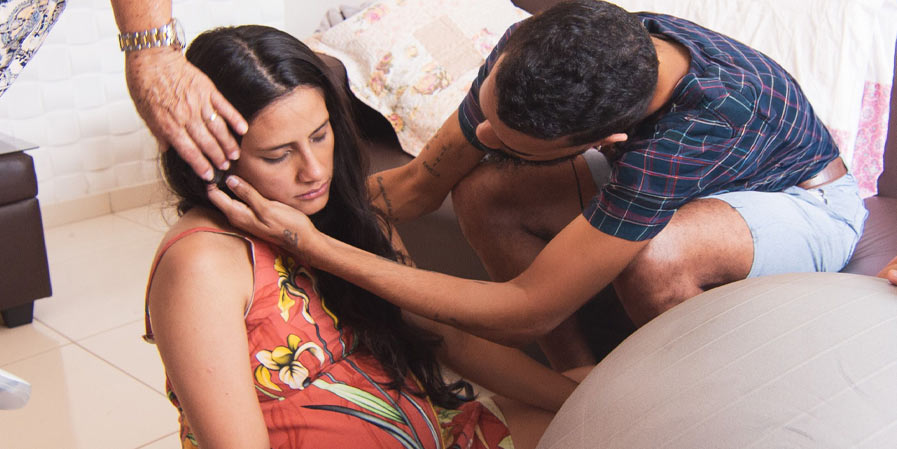
In a rural town’s closest tertiary maternity hospital, a soon-to-be father watches his pregnant wife struggle to communicate with a midwife, one who appears to be familiar only with caring for fluent English-speaking patients. The staff are able to start up a call with their Hindi interpreter, providing huge relief to the expecting couple. However, not every patient is this fortunate. When interpreters themselves are not a permanent fixture in hospitals, telehealth still falls short in the timeliness and continuity of care it’s able to provide.
In another town, a young boy eagerly anticipates his first virtual psychiatry appointment, having waited seven months to access this specialist service. He feels extremely grateful, knowing some of his friends had waited 12 months. The call goes well, but the boy’s internet is unreliable, leaving both parties unsure about the quality of their future appointments.
These experiences are not unique, and they’re certainly not rare. In fact, when provided the opportunity, multicultural community members across rural Australia have continually expressed similar stories that highlight how telehealth is a digital powerhouse, but one that is still limited.
For many who responded to an anonymous survey conducted by the Australian Multicultural Health Collaborative, which sought to better understand rural communities’ health experiences, telehealth has been transformative. Before video and telephone consultations became widely available, a routine follow-up appointment could mean an entire day lost of travel, unpaid leave from work, and the cost of fuel or a bus ticket.
However, many non-English speaking survey respondents described how they often delay or avoid telehealth altogether, not because it isn’t available to them, but because navigating it feels too hard. As one community member put it, people “do not know the system” and so they wait, sometimes until they can travel to a major city instead, or even until their condition worsens. Another respondent described the specific frustration of telephone consultations, where receptionists struggle with non-Australian accents and ask for clarification in ways that feel dismissive.
“It can feel disheartening,” they wrote, “when it seems like only certain accents are recognised or understood.”
It is clear the promise of telehealth is only as strong as what supports it.
Unreliable internet also remains a real barrier in many rural homes. Medicare subsidies, while helpful in principle, are seen by many as insufficient in practice, even for telehealth, where workforce shortages still mean there are fewer providers. For our multicultural communities especially, some don’t see these benefits at all as they don’t have Medicare access. “Either subsidies or incentives are not enough to get the same level of treatment and support as in the city,” one respondent observed.
For people already uncertain about how to access care, this kind of friction can be enough to stop them from trying.
Telehealth is an important tool, and in rural Australia it has already cemented itself as a non-negotiable. However, like any tool, it only works when it’s designed for the person holding it, and for our multicultural communities, this means outreach that meets people where they are, in languages they understand.
As one respondent put it: “Building trust within communities is just as important as providing the services.”
The expectant mother at the maternity hospital was lucky. The young boy did finally receive his first appointment. But a health system built on luck and long waits is not a good one.
The solution lies in what our communities have spoken clearly about, and this begins with a move beyond the expectation that offering telehealth alone was ever enough.
Rural healthcare remains the lifeblood of the nation's health system, grounded in community connection, resilience, and adaptability. As a nursing Read more
Two innovative and community-driven programs are tackling the vast distances and limited services that shape health and daily life in Read more
Walking into Northcliffe Family and Community Centre for the first time, two occupational therapy students and their supervisor are met Read more
Across rural and regional Australia, communities are ageing, and the shortage of health professionals is increasingly evident. At Beaufort and Read more