
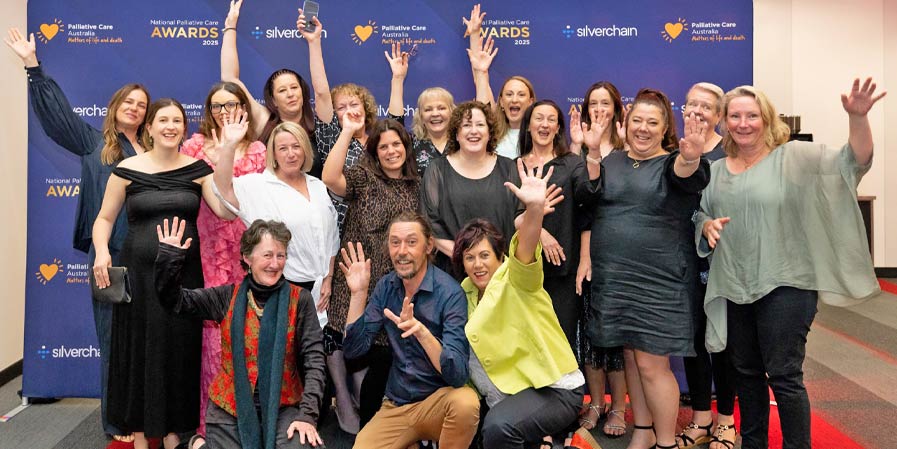

Palliative care helps people live as comfortably and meaningfully as possible when facing a life-limiting illness. It supports not only physical symptoms, but also the emotional, social, and spiritual concerns that shape a person’s final months or weeks. In regional and rural Australia, where specialist services may be limited, providing this type of holistic care is both challenging and essential.
On the Mid North Coast of NSW, Senior Palliative Care Pharmacist Felicity Bates has spent more than a decade working to bridge these gaps. As part of the Coffs Community Palliative Care team in a largely rural LHD, she combines medication expertise with compassionate, person-centred care focused on what matters most to patients and families living outside major metropolitan centres.
Through this work, Felicity noticed something often unseen but profoundly important: existential distress. While clinicians are skilled at managing pain and other physical symptoms, many patients experience suffering that is harder to articulate. In busy, often under-resourced rural settings, this emotional and spiritual distress can easily go unrecognised.
“In palliative care, we’re good at identifying physical symptoms, but we’re missing a whole layer of distress that isn’t visible on a chart,” Felicity shares.
Supported by a NSW Regional Cancer Research Network (NSWRCRN) Clinician Research Fellowship (funded by the Cancer Institute NSW) and the HETI Rural Research Capacity Building Program, Felicity undertook a study exploring how often existential distress occurs in rural palliative care and whether structured tools can help clinicians respond earlier. She implemented the Death and Dying Distress Scale (DADDS), a validated tool designed to identify distress arising from impending mortality, such as worries about one’s impact on others and fears about the dying process.
Her findings were striking. Many patients had never been asked about this aspect of their experience; others expressed relief at having language to describe how they felt. Felicity’s preliminary results, recently published in Palliative & Supportive Care, highlight the value of embedding this screening into routine practice so emotional and existential concerns receive the same attention as physical symptoms.
“Existential distress can’t be treated with a standard medication chart,” Felicity reflects. “It needs time, conversation, and compassion. The DADDS has opened the door to conversations we weren’t having before, and it’s changing the way we connect with patients.”
Her work has also propelled Felicity into national advocacy. Recently, she was invited to Parliament House to speak at the Parliamentary Friends of Palliative Care panel session. Representing pharmacists across Australia, she outlined key challenges facing rural palliative care – including managing complex medication regimens, medicine shortages, and ensuring safe home administration. The importance of Felicity’s work is further highlighted in the recent Lancet Oncology Commission, which calls for recentring the human experience in cancer and palliative care, including invisible suffering such as existential distress.
Felicity’s goal is to see routine screening supported by dedicated psychological resources and policy frameworks that recognise the full spectrum of suffering at the end of life. Her broader program of work also explores how existential distress may interact with medication use – an area with significant implications for rural practice.
Felicity’s journey shows what’s possible when rural clinicians are supported to lead research driven by local need. Building on her research training and postgraduate studies at the University of Newcastle, she is turning evidence into better care and stronger services across regional NSW. Her work demonstrates that advancing rural health research and innovation isn’t only about generating data, it’s about changing conversations, shaping services, and ensuring that people in rural and remote communities receive care that honours dignity at the end of life.
In regional South Australia, a quiet revolution in dementia care is underway. With over 400,000 Australians currently living with dementia Read more
About 1,535 kilometres north of Perth in Western Australia’s Pilbara region sits the fascinating city of Karratha. Built on the Read more

Rural mental health professionals face unique challenges – from professional isolation to high caseloads and limited peer support. But innovative Read more
One third of Australians live in rural, regional, and remote areas. Delivering quality health education, research, and services to these Read more