
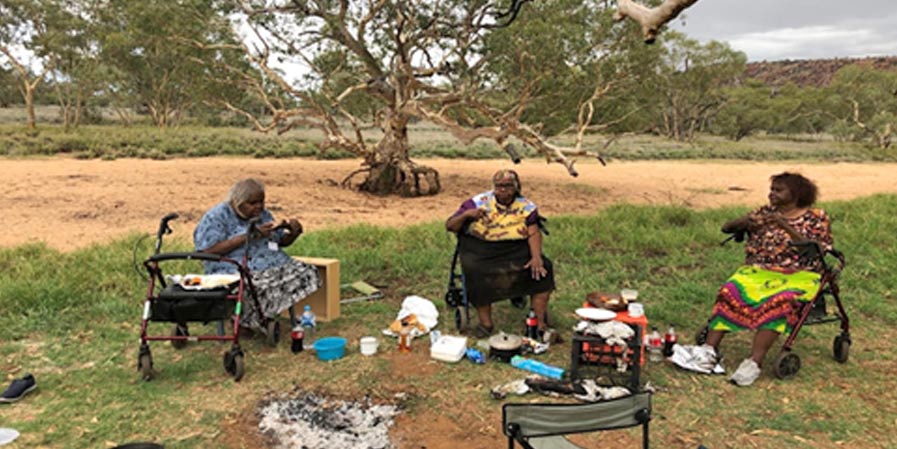
The Early Intervention Healthy Ageing Program, funded by the Australian Government and delivered through Northern Territory Primary Health Network (NT PHN), supports older people to maintain their health, independence, and connection to community. The program commenced in 2023 and is being delivered by various service providers, reaching over 800 older people across the NT.
A recent evaluation assessed the effectiveness, appropriateness, and outcomes of the program, and found strong evidence that it is having a positive impact on older people’s social participation, confidence, physical function, and access to culturally safe health and wellbeing activities.
The evaluation identified that models that incorporate approaches to older age around concepts of social roles, community connections, cultural identity, and holistic understandings of health have the potential to deliver health and social outcomes that are meaningful to older people. In the Healthy Ageing Program, older people consistently prioritised social connection, group activities, cultural outings, and access to basic services.
The evaluation concluded that Healthy Ageing providers that prioritised these needs and preferences had the most positive impact on their clients. Participants were mostly interested in activities which allowed time for storytelling, connection to Country, and cultural practices like cooking bush food. This reinforces the fact that wellbeing outcomes are inseparable from cultural and social wellbeing.
The following is a reflection from a program provider, sharing a participant’s experience of how the program has impacted the wellbeing and quality of life of older people (names have been changed):
“During one Deadly Wobblers exercise group, there was a new participant Adam joining for the first time. As we brought Adam in, another participant James locked eyes with him and they spoke to each other in Luritja. Adam began to cry as it turned out that they had known each other as younger men and that James has been particularly close friends with Adam’s brother – who had since passed away. The two men had an opportunity to re-engage with each other and catch-up on years of news.
“This is a common experience in our groups with many of the older people knowing each other or being related through family or kinship. While the main reason for the group is physical exercise, the social and cultural benefits of older people coming together can be stronger at times. Participants often radiating with happiness on the drive home after having reconnected with a distant family member or friend. This addresses social isolation in the elderly population, which is a significant issue, particularly in remote areas where additional barriers occur including poor transport, equipment and social service availability.”
The evaluation’s recommendations include creating more opportunities for Healthy Ageing service providers to share examples of best practice and positive impact. The reflection provided in this story illustrates the potential of learning from each other and identifying the program models that deliver the best outcomes for older people. Other recommendations included supporting two-way capacity building approaches that both empower older people and support providers to build their capacity to better respond to the health and wellbeing needs of older people. It also recommended better alignment of program activities with holistic definitions of health and wellbeing, incorporating cultural activities, social connection, storytelling, time on Country, and group-based formats rather than overly clinical or individualised models.
NT PHN continues to be committed to funding services that support older people in the NT to age in place and access quality programs that meet their needs.
A full copy of the evaluation will be made available soon on the NT PHN website
From the far reaches of Cape York to the rugged beauty of Kangaroo Island, Angel Flight is proud to have Read more
At the Whyalla Hospital’s foyer every weekday morning, greetings & conversation hums between customers and volunteers, at a booth located Read more
Tresna is 75 years old and resides in Deniliquin, an idyllic country town (MM4) in southern New South Wales, nestled Read more
For many older people in rural Australia, staying connected, physically active, and mentally sharp can be challenging. Long distances, fewer Read more