
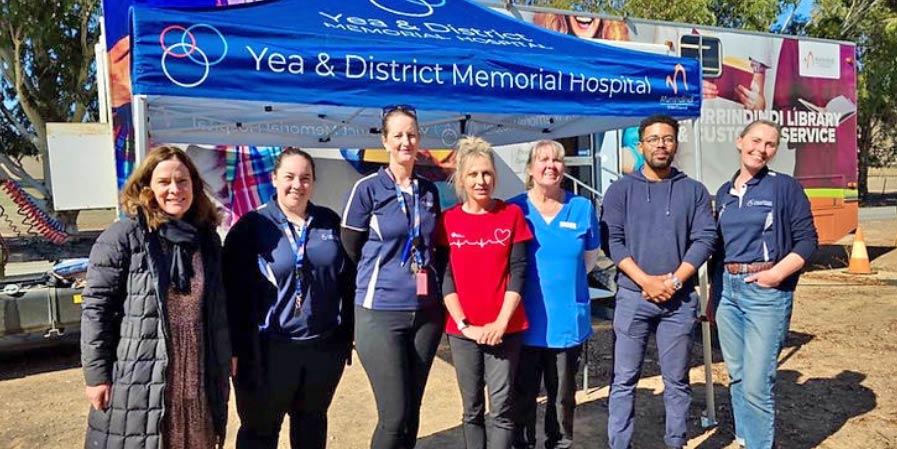
Our research setting today is the local saleyards in Yea – on Taungurung land – where the familiar and comforting rituals of regular cattle sales are taking place. This is my hometown. My great grandfather selected land and farmed here on the fertile river flats along the Gungupna (Goulburn). Farmers, auctioneers, transport operators and others gather against a reassuring and familiar backdrop of cattle, noise, dust, smells and movement. This trusted space, where generations of farmers have gathered through life’s ups and downs, offers a social connectedness missing from everyday farming life.
As one farmer told me, “You can go a whole week without seeing anyone, but here you catch up on everything — cattle, weather, and what’s really going on.”
I am privileged to be here in my role as a Rural Health Academic Network Research Coordinator – a research partnership between the Melbourne University Department of Rural Health and the Yea and District Memorial Hospital. This partnership enables meaningful collaboration between academic and clinical partners to improve health outcomes, build research capacity, and strengthen healthcare delivery within rural and regional communities.
We are evaluating the effectiveness of a new program implemented by the Yea Hospital – providing free health check clinics for farmers at these sales, and they have welcomed us and our program into this unique environment. As one farmer reflected, “It’s good they’re (the clinics) here — I wouldn’t have gone into town to have this check done otherwise.” Our approach emphasises the importance of understanding the connectedness between people and their environments, and how these dynamics influence health behaviours, access to care, and health outcomes. As we often hear: “It’s good to talk to someone who understands farming — they get the stress side of it too.” The clinics are now a part of the fabric of this space. The farmers are keen to talk to us, and our research interviews blend into the cacophony of birdsong, auctioneers chant, cattle bellowing and banter.
Importantly, this initiative reflects the strength and generosity of local partnerships. The program’s ongoing success has been supported through community funding, including the Rotary Club of Yea’s sponsorship of the farmer health checks, and the purpose-built facility made possible by a generous grant from Elders. These contributions demonstrate how local organisations, industry, and health services can come together to create sustainable, community-led health solutions that make a tangible difference.
It has been such a pleasure to be back, sharing both the space and the mateship. It is an interesting irony that farmers are notoriously neglectful of their own health and wellbeing, whilst holding the welfare of their stock as their main focus. As one farmer put it, “We look after the cattle first — they’re our livelihood. We’ll get checked when we’ve got time… but there’s never time”. Here we have blended the health of both, highlighting the interconnectedness of farmer and animal wellbeing.
By the way, cattle prices were up!
Rural mental health professionals face unique challenges – from professional isolation to high caseloads and limited peer support. But innovative Read more
Across rural Australia, health professionals work tirelessly to deliver care in places where distance, workforce shortages and limited infrastructure and Read more
One third of Australians live in rural, regional, and remote areas. Delivering quality health education, research, and services to these Read more
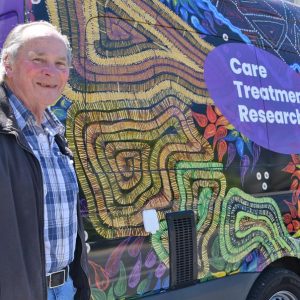
Grampians Health has launched a dedicated mobile clinical trials unit bringing research, innovation, and care directly to Western Victorian regional Read more