
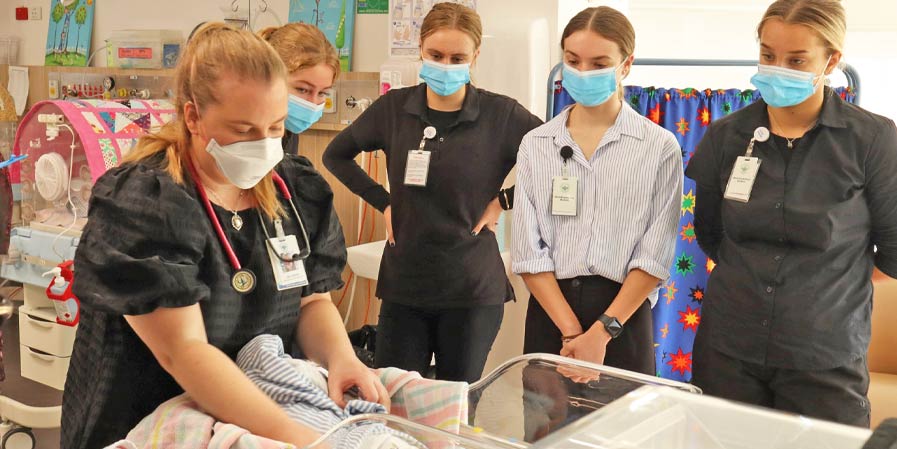
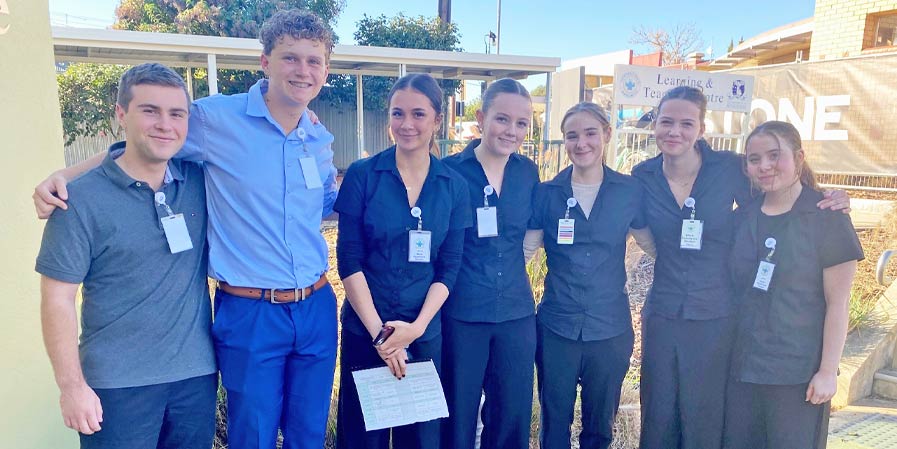

All health services have challenges with staffing, not least in rural areas. One solution lies in well-designed work experience programs that can inspire early interest, build local skills and create a pipeline of future professionals committed to serving their communities. Recognising and engaging with local young people helps rural health services to face the pulling forces upon smaller local labour pools from larger and metropolitan centres that may be seen as offering more opportunity.
For Di McIntosh, Student Coordinator at Northeast Health Wangaratta (NHW) in Northeast Victoria, one answer is recognising students in rural communities who have an interest in healthcare and providing the opportunity for them to experience healthcare workplaces directly:
“When I was in Year 10 at Wangaratta High I was interested in becoming a paediatric nurse and applied for Work Experience at Wangaratta Base Hospital, as it was called then. But instead of anything clinical I was assigned to the kitchen and washed dishes for five days.”
Di was not deterred and pursued her passion of nursing, training as a paediatric nurse before joining the Education Unit at NHW in 2005. In this role, Di got the opportunity to redesign the Work Experience program. “I remembered my own experience and knew this was something we could fix, so was keen to get to work,” she said.
Students with a clinical interest can now apply to participate in a work experience program with direct clinical exposure and see firsthand what working in healthcare is like. Students rotate through different clinical areas over four days, with a midweek break and daily debriefing sessions. As Abbey, a Year 10 student from Virtual School Victoria explains, students get to see and be inspired by a range of clinical services:
“I chose to do work experience at Northeast Health Wangaratta because I have a dream of one day becoming a Nurse or Midwife and wanted more experience in the hospital to see if I liked anything else … I went in wanting to be a nurse or midwife and thinking it will just tell me that’s what I definitely want to do, but instead came out enjoying every area as much as the last.”
Older students can return in Year 11 or 12 for a specialised program shadowing specific clinicians or teams. For Di, this has been one of the most successful and impactful parts of the Work Experience program:
“Students who have a real interest in one area really benefit from working alongside a Physio or Doctor or Radiographer, for example, and seeing the reality of that work. The staff enjoy it because they get to share their passion for their work with the next generation and see their coworkers grow all the way from school student to colleague.”
For Abbey, direct involvement was one of the most valuable parts of placement. “Other hospitals may only let you sit at the reception and watch people check in while at Northeast Health you felt like you got to be a nurse yourself, you were treated and given the responsibility of an adult and it was the best experience ever,” she said.
Under Di’s leadership, placement spots have grown from 40 per year in 2016 to 88 in 2024, with full bookings and waitlists in 2025. Nearly 20 per cent of work experience students from 2016 to 2018 had returned to NHW as staff by 2024, showing that clinical work experience programs are an effective way to inspire students in rural communities to pursue careers in healthcare. We think other rural health services should consider this model for themselves.
More information and contact details for the Work Experience Programs are available at the NHW website, here.
Acknowledgements: This writing of this article has been supported by the Australian Government Department of Health Rural Health Multidisciplinary Training program.
We would also like to acknowledge the drafting assistance and guidance of Dr Kristen Glenister from the University of Melbourne Department of Rural Health.
Rural healthcare remains the lifeblood of the nation's health system, grounded in community connection, resilience, and adaptability. As a nursing Read more
Two innovative and community-driven programs are tackling the vast distances and limited services that shape health and daily life in Read more
Walking into Northcliffe Family and Community Centre for the first time, two occupational therapy students and their supervisor are met Read more
Across rural and regional Australia, communities are ageing, and the shortage of health professionals is increasingly evident. At Beaufort and Read more